

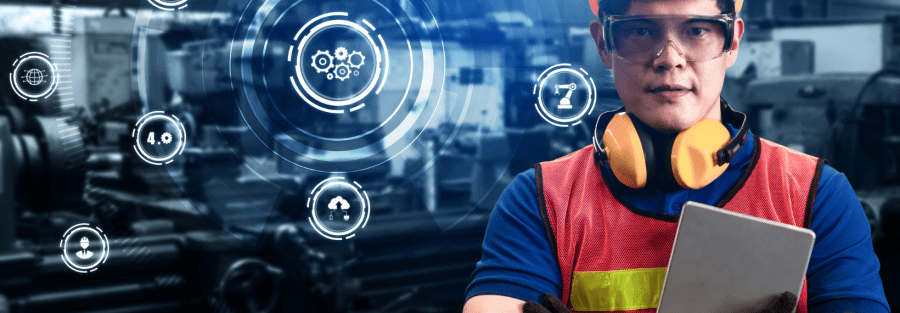
As the world moves rapidly towards the Fourth Industrial Revolution or “Industry 4.0”, companies around the world must get ahead of the technology curve if they want to remain competitive. Much of that change revolves around advances in automation, the Internet of Things (IoT), data-driven decision-making, and machine learning. Although these terms may seem complex at first glance, they all point to a singular goal: to bring more efficiency and cost savings to industrial companies around the world.
Industry 4.0 can bring a number of transformative changes to organizations. For example, integrating smart technologies and analytics into industrial processes can help reduce operating costs, improve safety, minimize errors and waste. In addition, Industry 4.0 encourages mass customization and greater transparency in all companies.
To understand the full scope of Industry 4.0, let's take a closer look at the technologies and concepts driving this revolution:
Data sharing and use
Within Industry 4.0 is the idea of sharing and using data. Organizations can collect data from multiple sources, including IoT devices, machine logs, and sensors to gain a holistic view of their operations. This data is used to inform decisions and streamline operations. For example, organizations can use predictive analytics to anticipate customer demand or identify potential savings opportunities.

Advanced automation
Industry 4.0 not only changes the way organizations collect and use data, but also the way they automate tasks. With advanced automation technologies, such as robotic process automation (RPA), solutions can be developed to reduce manual tasks and improve the efficiency of industrial processes. Additionally, augmented reality (AR) and virtual reality (VR) can be used to engage employees at work and reduce downtime in service industries.
Digital twins
Another key element of Industry 4.0 is the concept of digital twins, or virtual replicas of industrial processes and production lines. By collecting data from connected IoT devices and sensors, organizations can build accurate digital models of their companies to understand how changes in processes or production lines affect their operations. Digital twins also allow companies to make “hypothetical” scenarios to better inform their decision-making.
Industry Profits ($)
Industry 4.0 can bring companies a number of advantages. For example, organizations can be more agile and adaptable to changing market and customer demands. They can also better understand their operations to facilitate better decision making, and can increase the productivity of their staff and streamline operations. In addition, increased automation can result in cost savings and allow organizations to reallocate resources to other areas.
Risks
Industry 4.0 also carries certain risks. For example, you can create cybersecurity vulnerabilities by connecting previously unconnected systems and machines. In addition, organizations must ensure that their infrastructure supports the influx of data and processes associated with Industry 4.0. Finally, companies must have the resources to adapt quickly to this new wave of technology, or they risk falling behind their competitors.
Conclusion
Industry 4.0 brings with it a series of transformative changes for organizations in the manufacturing and production sectors. With advanced automation and data collection capabilities, companies can innovate faster, be more efficient and cost-effective. However, to reap the full benefits of this new industrial revolution, organizations must understand the potential risks associated with Industry 4.0 and have the necessary resources to take full advantage of this revolution.

